May 19, 2026

MAY 19, 2026, selected pics: geese with goslings


a goose family relaxing in the shade
 on a warm mid-May mid-day


Authors' Note:  The above photos display recent sightings in Mt Pleasant SC, near the base of the Arthur Ravenel Bridge to Charleston SC.
You can view an illustrated poem about Canada geese, including goslings, HERE. And, there's a photo-collage that you can access HERE. 

These blogposts feature Canada geese who have made their permanent homes in both the US, as here, and in Canada.

The authors of this piece avoid comments on birthright dual citizenship, and leave readers to draw their own conclusion. 

May 17, 2026

MAY 17, 2026, the Charleston garden: creeping fig


TO ENLARGE any slide or stand-alone photo on this blog, just click on it. To reverse the process, and return to this standard view, find the little 'x' in the upper right corner of the black field and click there.


You can review these illustrated verses in a wider context by proceeding to 'Poetry Praising the Charleston Garden' on the full-service blog 'Edifying Nonsense'. Click HERE!


May 15, 2026

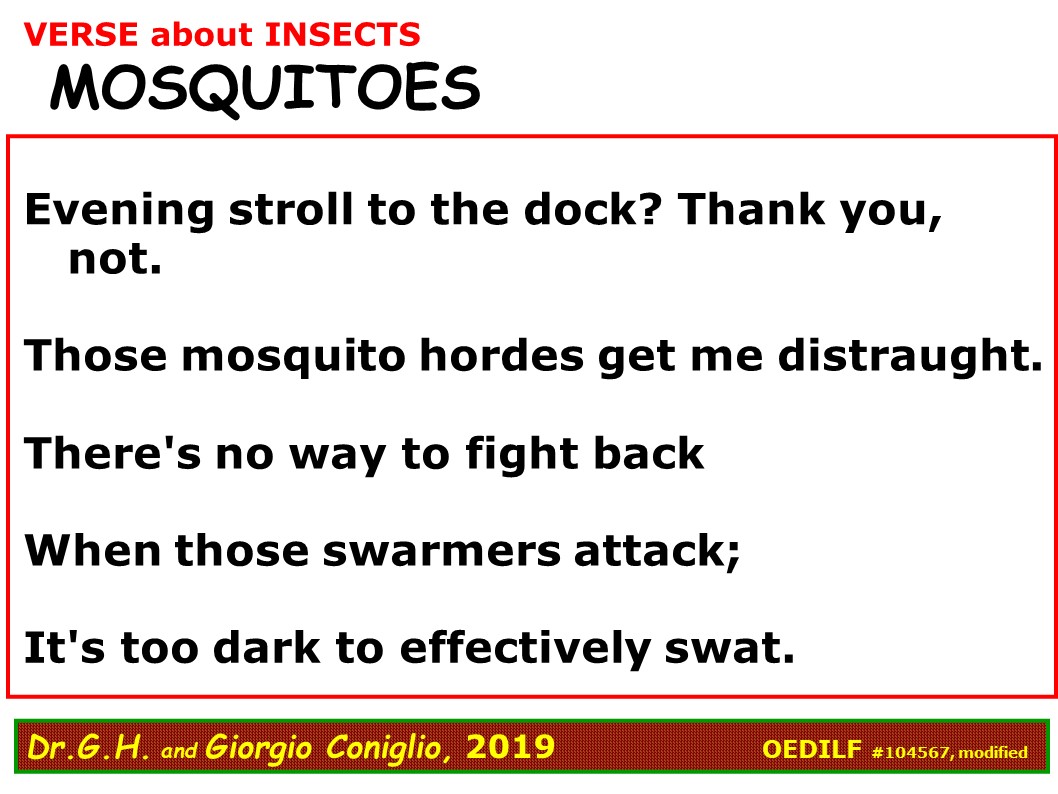
MAY 15, 2026, insects: mosquitoes


You can review Giorgio's other verses about pesty and occasionally beneficial insects, as  collected in 'Buzzwords: Verses about Insects' on the full-service blog "Edifying Nonsense". Click HERE.

May 13, 2026

May 11, 2026

MAY 11, 2026, terminal (poetic) exclamation: "HOLY MOLY!" -- peeping-Tom lizard


poetry lyrics:/ As a curious lizard (anole),/ I climb up your window-frame slowly;/
And unnoticed, I'm creeping/ To a niche where I'm peeping/ In your 'people house'.
Gosh! "HOLY MOLY!" 


upside-down: reflection in a bathroom window


this green anole displays similar curiosity about human activities
to Dr Seuss's bird-narrator from his classic "In a People House"


May 9, 2026

MAY 9, 2026, bar-fauna: (loon's) unscheduled flight


If you liked this offering, you might want to refer to our entire collection of verses about human and animal denizens of bars, pubs and other watering-holes. Click HERE.


May 7, 2026

MAY 7, 2026, selected pics: London-canal bird-babies


Photos from canal locales in London, UK, were kindly provided by Josh.


a family of coots


a mute swan family

Authors' Note:  The above photos display the wildlife in easy view along the waterways of the London canal system, of which Regent Canal is the portion best known by North Americans.
May is the time to see the fledgling birds on both sides of the Atlantic, and readers might enjoy the images of Canada-goose goslings found on our recent post.

May 5, 2026

MAY 5, 2026, waterfowl: shelduck (visitor)


poetry lyrics:/ Quacked the shelduck, "With no GPS/ We migrate. In high winds,
 we digress/ From our usual flight-path./ So one dark-stormy-night path,/
We land here, refugees in US/ (They prefer that we leave, that's my guess). 


Authors' Note:  The above photos commemorate the unusual sighting of a shelduck, a handsome European duck species, in Brooklyn, New York, USA, in early May, 2026. This particular bird was noted in the company of native mallard ducks swimming and feeding in a pond at the Prospect Botanical Garden. The bird-visitor is distinguished by its red face-plate, longitudinal black body stripes and horizontal brown belly stripe.

Occasionally, Eurasian species like the shelduck are forced off course in their migration southward from Europe to Africa by major storms, and land up along the Atlantic seaboard of the United States; this circumstance was at play here, as particularly bad weather had preceded our visit to New York City at the beginning of May. Attributable to the same storm, You-tube had posted a video of a visit to a Pennsylvania pond where a local duck expert had clinched a similar unusual sighting.     


May 1, 2026

MAY 1, 2026, selected pics: yellow-crowned night heron


Authors' Note:  The above photos were taken by Giorgio Coniglio near the Charleston harbour in May 2026. The bird is focused on hunting in the pluff mud 
(sludge) at low tide, likely for small fish, small reptiles, and its favorite foods -- crabs and crayfish. 

You can review an illustrated poem about these herons, native only to the Americas, HERE.