ORIGINAL PARODY SONG-LYRICS
The music was first developed as "Leningrad Nights" by composer Solovyov-Sedoi and poet Matusovsky in 1955, but changed at the request of the Ministry of Culture for use in a documentary about a national athletic competition. The tune was subsequently popularized in the West, in the middle of the Cold War era, by Van Cliburn in 1958, and recorded with commercial success by Kenny Ball and the Jazzmen, and the Chad Mitchell Trio in the early 60s.
(to the tune of "Moscow Nights")
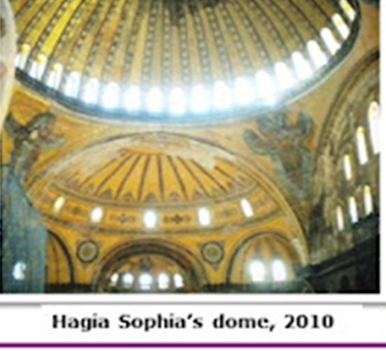
Boasts Byzantion’s seer, “Constantine will found,
Nova Roma, his new cosmopolis.
They’ll construct right here;
Then we Greeks will cheer
Rome’s second home: Constanti-no-po-lis.”
“In Rome’s legions march with a martial sound,
They’ll build Fourth Century’s eastern metropolis —
Grand Sophia’s dome,
And a huge Hippodrome
Rome’s second home: Constanti-no-po-lis.”
“Who’ll unite this Empire too vast to rule?
Few the Caesars who exert such might.
Year 3–95 (A.D.),
Things take a woeful dive —
East/West splits; West drops out of sight.
“In clean-shaven West, ‘barbarians’ storm the gates,
Middle Ages settle there to stay.
Vandals, Lombards, Goths –
Old stomping grounds get lost,
Down East here, ‘Roman’ power holds sway.”
“Who will dogma craft for new Christian creed?
Peter’s primacy; Roman popes’ll.
We’ll counter Holy See
With Eastern Orthodoxy,
Here in Byzantine Constan-ti-nople.”
“Vicious wars with neighbours” quoth our sooth-saying seer,
Peering in his Prophet-Kit prism,
“Charlemagne and Popes”
Will undermine our hopes,
Split our Faith with an East-West Schism.”
“Fate takes a bad turn with the Fourth Crusade,
Frankish knights, their mission quite hopeless —
Retake Holy Lands?
“Such risk!” They change their plans,
Seize and ‘Latinize’ Constantinopolis.”
“Fifty years to rid the place of Latin louts
Then two centuries, invasions we’ll stop. All this
Has an end, it’s clear,”
States our seer, with tear,
“When Turks topple Constantinopolis.”
Then we took our seer out for lunch that day
To a small café by the Bosporus.
Name of the café
|Where we ate that day,
Was ‘Istanbul (Not Constantinopolis)’.
* the prediction was made by the Seer early in the fourth century A.D.
Byzántion (Greek), later known as Byzantium (Latin) was at that time a moderate-sized Greek colony-city on the Bosporus. It was chosen by the Roman Emperor Constantine to become the eastern capital of his empire.
As capital of the Roman Empire (also called Romania), the grand city was known as Constantinopolis, or Konstantinoupolis, for most of its history, i.e. until 1453 A.D. (later as Istanbul by the Turks). The term ‘Byzantine Empire’ has only been in use by Western historians since that time.


.jpeg)


